AI Software Engineering Track
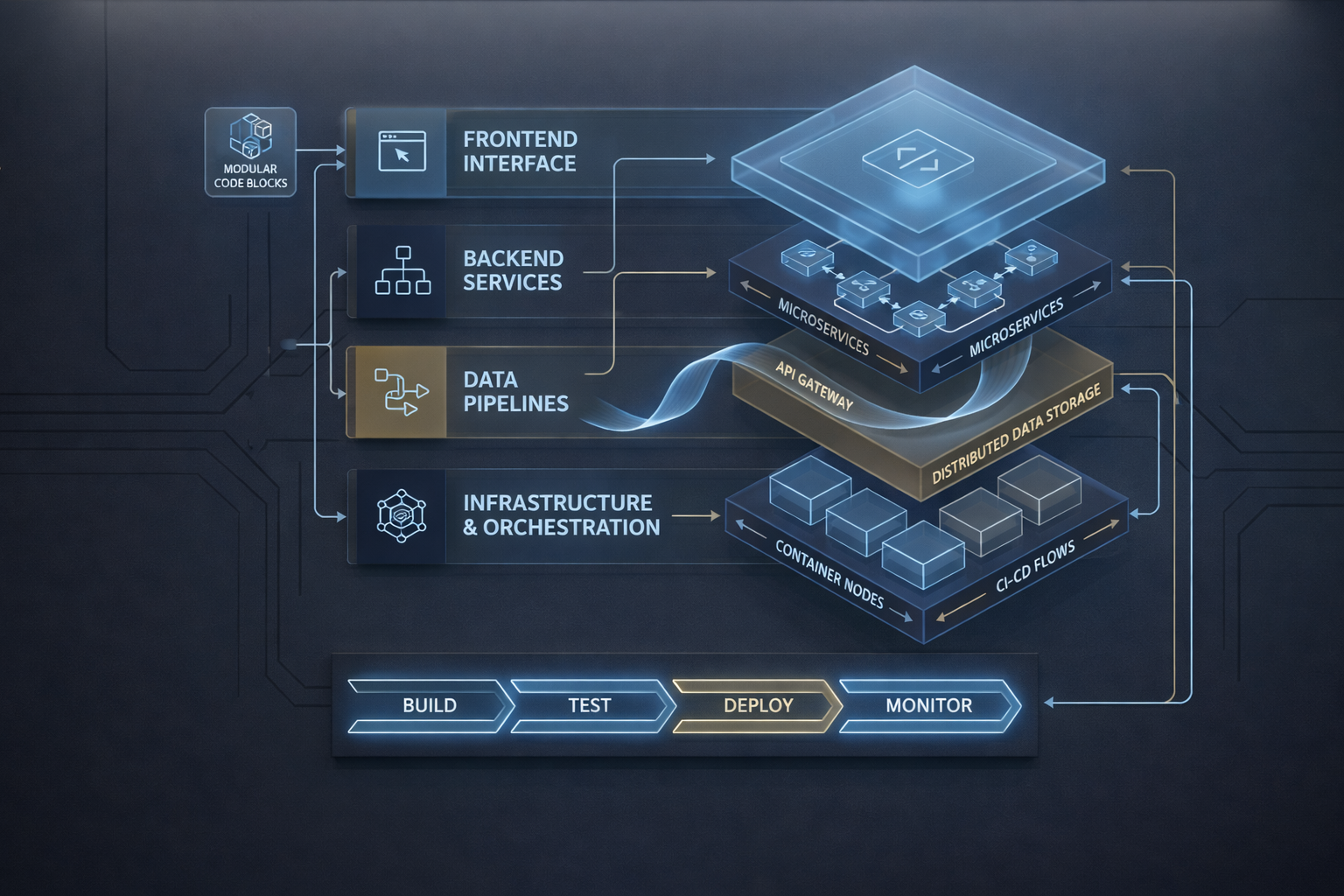
Goal
Build production-grade, scalable systems. Learn the architecture patterns, tools, and practices that distinguish hobby projects from enterprise software.
1. Networking Fundamentals
Core Concepts
Computer Networking Course
Alternatively, complete the full Systems & Networking module for deeper understanding.
Understand how data travels to debug and optimize effectively.
Key Topics:
- OSI Model: Layers 3-7 (Network to Application).
- Protocols: TCP/IP, DNS, HTTP/HTTPS.
- Performance: Load balancing, CDNs, SSL/TLS.
The TCP/IP Model
TCP/IP vs OSI Models
The mental framework for debugging. If you can't connect, check the layers from bottom to top.
- Link Layer: Physical hardware (Ethernet, WiFi).
- Internet Layer: Routing across networks (IP addresses).
- Transport Layer: Reliable delivery (TCP) or fast streaming (UDP).
- Application Layer: User-facing protocols (HTTP, SSH).
TCP/IP in Practice
Real-World TCP/IP
- TCP Handshake: SYN, SYN-ACK, ACK. Ensures reliable connections (used by HTTP/Web).
- UDP: "Fire and forget". Faster but less reliable (used for video streaming).
Action Items:
- Watch videos on OSI model and HTTP.
- Use
ping,traceroute, andcurlto trace requests. - Analyze a website's traffic using Browser DevTools.
- Memorize the 4 layers of the TCP/IP model.
- Use Wireshark (optional) to observe a TCP handshake in real-time.
2. Architecture Principles
Core Concepts
The Twelve-Factor App
Beyond the Twelve-Factor App
Learn the battle-tested patterns that make applications scalable, maintainable, and cloud-ready.
Key Topics:
- 12-Factor App: Config, Backing Services, Disposability, Dev/Prod Parity.
- Cloud-Native: API-first design, Telemetry, Authentication strategies.
- Scalability: Stateless processes, Horizontal scaling.
Action Items:
- Read the 12-Factor App methodology.
- Audit a previous project against the 12 factors.
- Draft an architecture document for a new service.
3. API Design & Implementation
Core Concepts
REST API Tutorial
FastAPI Official Tutorial
Master RESTful API design and build high-performance endpoints using modern Python frameworks.
Key Topics:
- REST: Resources, HTTP Methods, Status Codes, Versioning.
- FastAPI: Path operations, Pydantic models, Async endpoints.
- Documentation: Automatic OpenAPI (Swagger UI) generation.
Action Items:
- Design a REST API schema for a blog or library.
- Build a CRUD API using FastAPI with Pydantic validation.
- Implement JWT authentication and error handling.
4. Database Design & Management
Core Concepts
SQLBolt
Alembic Tutorial
Design efficient schemas and manage data integrity.
Key Topics:
- Design: ERD, Normalization (1NF-3NF), Indexing.
- SQL: Joins, Transactions, ACID properties.
- Migrations: Version control for database schemas.
Action Items:
- Create an ERD for an e-commerce system.
- Implement the schema in PostgreSQL and write complex queries.
- Set up Alembic for automated migrations.
5. Testing Strategies
Core Concepts
pytest Documentation
FastAPI Testing Tutorial
Write automated tests to catch bugs early and refactor with confidence.
Key Topics:
- Types: Unit, Integration, End-to-End.
- Tools: pytest fixtures, mocking, coverage reports.
- TDD: Writing tests before implementation.
Action Items:
- Write unit tests for all API endpoints.
- Achieve 80%+ code coverage.
- Configure tests to run on every commit.
6. DevOps & Deployment
Core Concepts
GitHub Actions Documentation
Docker Compose Documentation
Automate deployment and ensure reproducibility with containers.
Key Topics:
- CI/CD: Automated testing, linting, and deployment pipelines.
- Docker: Containerizing applications for consistency.
- Orchestration: Managing multi-container apps with Docker Compose.
Action Items:
- Create a GitHub Actions workflow to run tests on PRs.
- Containerize the FastAPI app and database.
- Deploy the stack using Docker Compose.
7. Specialization (Choose One)
Option A: Mobile Development (Flutter/Swift)
Flutter Codelabs
Goal: Build a mobile app consuming your API. Key Topics: Widgets, State Management, API Integration.
Option B: Full-Stack Web (React/Vue)
React Tutorial
Vue Guide
Goal: Build a responsive web app consuming your API. Key Topics: Components, Hooks/Composition API, Routing.
Note: For deeper integration and deployment practices, see the Infra Basics module.
Project Requirement:
- Implement a frontend (Mobile or Web) for your API.
- Include authentication and data visualization.
Capstone Project
Build a full-stack production application with microservices, databases, containerization, CI/CD, and a frontend.
Track Completion Checklist
- Explain HTTP request lifecycle.
- Design scalable REST APIs (12-factor).
- Normalize database schemas (3NF).
- Write complex SQL queries.
- Achieve 80%+ test coverage.
- Deploy with Docker Compose and CI/CD.
- Build a full-stack application.
Support & Resources
Channels: #software-arch, #backend-dev, #devops-help
Office Hours: Wednesdays 3-6 PM
Next Steps:
System Design Primer
- Cloud Certifications (AWS/GCP)
- Technical Interview Prep